Expanding Your US Company to Europe
If you’re planning to expand your business to Europe from the USA, you’re not just entering a new market. You’re entering 27 different legal systems, each with its own employment law, payroll rules, and tax requirements. For most American companies expanding to Europe, the biggest question is whether you set up a legal entity in every country you hire in, or work with a partner who already has the infrastructure in place.
This blog walks through what US companies expanding to Europe need to know before making that decision. We cover the realistic costs, the timelines, and the role an Employer of Record (EOR) plays in helping you hire in Europe from the USA without months of legal setup. Already looking at a specific market? Start with our guide to hiring in Germany as a US company, one of the most common first steps into Europe.
Why American companies are expanding to Europe right now
Europe remains one of the most attractive regions for US businesses looking to scale internationally. A combined market of over 450 million consumers, deep pools of specialised talent, and strong infrastructure make it a sensible next step once the US market starts to mature. Many American companies expanding to Europe are also responding to client demand. Winning a European customer or partner often means needing a local presence, or at least a local employee, to support the relationship.
The challenge is that “Europe” isn’t one market. Hiring an employee in Germany works nothing like hiring one in France, the Netherlands, or Spain. Each country has its own contract requirements, social security contributions, notice periods, and termination rules. That complexity is exactly why so many US companies look for a European expansion guide before committing to a specific structure.
Two ways to expand your business to Europe from the USA
Broadly, there are two paths for a US company that wants to hire in Europe.
1. Set up a legal entity
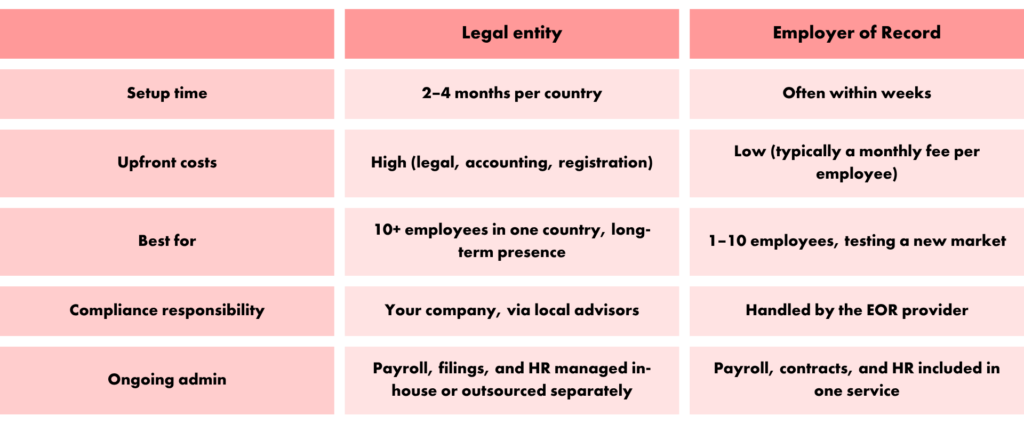
Registering a subsidiary or branch office gives you full control and a permanent local presence. It’s the right long-term move if you plan to hire dozens of employees in a single country. But it’s slow and expensive. Entity setup in most European countries takes between two and four months, requires local legal and accounting support, and comes with ongoing compliance obligations such as payroll administration, statutory filings, and registered office requirements.
2. Use an Employer of Record (EOR)
An Employer of Record for a Europe-based hire lets a US company employ staff in a European country without setting up a local entity. The EOR becomes the legal employer on paper, handling the employment contract, payroll, tax withholding, social contributions, and compliance. The employee, meanwhile, works exclusively for, and takes direction from, your company. For most US companies expanding to Europe with fewer than 10 employees in a given country, this is the faster and lower-risk route.
Here’s how the two approaches compare:
How an Employer of Record helps you hire in Europe from the USA
When an American company expanding to Europe works with an EOR, the process generally looks like this:
- You select the candidate. Recruiting and final hiring decisions stay entirely with you.
- The EOR drafts a locally compliant employment contract, in the local language where required, covering salary, benefits, leave, and termination terms under that country’s labour law.
- The EOR runs payroll, withholds the correct income tax, and remits social security and pension contributions on time, every month.
- The EOR manages statutory benefits and any mandatory insurances, and keeps you compliant as local regulations change.
- Your new hire works day-to-day as part of your team, using your tools, reporting to your managers, and representing your company.
Because no entity registration is required, this route typically lets a US company make a first hire in a new European country within a matter of weeks rather than months.
What to check before you choose an EOR partner
Not all Employer of Record providers operate the same way, and the differences matter once you’re relying on them for compliance in a country you don’t have local expertise in. Before signing, US companies expanding to Europe should ask:
- Does the provider have its own legal entities in the countries you’re hiring in, or does it rely on a network of third-party partners?
- How quickly can a new employment contract actually be issued?
- How does the provider handle edge cases where local labour law gets complicated?
How Parakar supports US companies expanding to Europe
For American companies expanding to Europe, Parakars local depth makes a practical difference. You work with experts who coordinate compliance, payroll, and HR support across the countries you’re hiring in, backed by Parakar’s own local presence in each market.
If you’re a US company that’s made your first European sale, signed your first European client, or simply identified the talent you need to hire, Parakar can advise on the right structure for your situation. Whether that’s an EOR arrangement to start fast, or a roadmap toward entity setup once you’ve scaled. Get in touch with our experts to discuss how Parakar can support your move to Europe. Ready to take the next step? See how we help US companies hire employees in Europe, from a first hire to a team across several countries.